
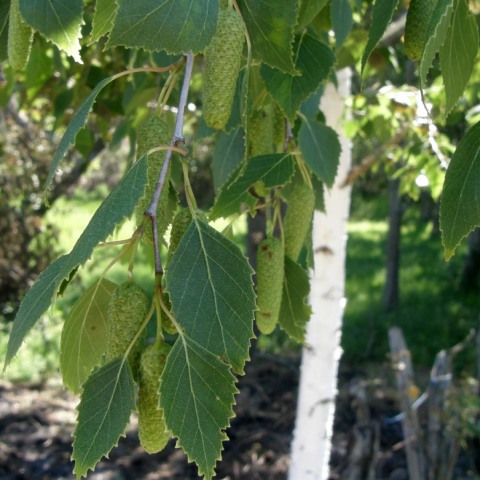
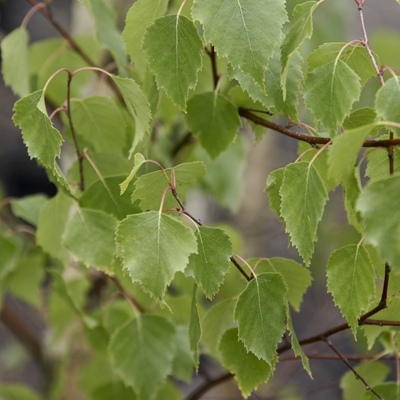
Effects: Birch is a natural pain reliever containing salicylate, the compound found in aspirin. Salicylate relieves the inflammation and pain associated with osteoarthritis,rheumatoid arthritis, gout, and generalized muscle pain. An other reason birch calms arthritis and gout is it's cleansing diuretic action that eliminates toxins and excess water. Sweet birch can have good results against cellulite. Diuretic, bacteriostatic, blood-purifying, it can be used as a remedy against hair loss, diarrhoea, dandruff, ekzemas, oedemata and allergies
Use: It makes a good ornamental garden tree, as it does not grow too large. Like alder, its seeds are popular with small seed-eating birds such as siskin and redpoll. Birch wood is not durable and is used in the Nordic countries for making quality paper; it is also used for plywood. The young leaves can be eaten and are often used as a spread for bread, teas, baths, compresses and face lotions are also produced from the leaves.
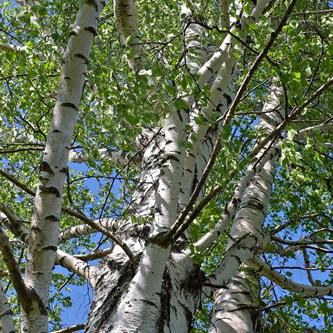
Background information: There are two species of birsh in Ireland, silver birch and downy birch. Birch is a colonising tree, and is thought to be one of the first trees to have made it to Ireland after the last ice age; they are more tolerant of poor soils than most trees, and can act as a nurse species to other species which take longer to establish. They are quick growing, short lived, and grow to around 25 metres. The leaves contain flavonoids, other parts of the tree can be used too
[wpspoiler name=”Where to find it”]Ireland: Birch woods occur widely, especially on marginal soils, lake edges, such as Lough Ennell Co. Westmeath, fens and on dried out bogs such as Ardkill Bog, Co. Kildare. Birch is typically associated with the Sperrins, growing in peat at the edge of bogs, and on the light sand and gravel soils. Birch will grow in poor soils, but likes a sunny position. Downy birch is tolerant of wet sites, but silver birch needs good drainage.
Greece: Can be found in northern Greece in high altitudes and cold areas. Prefers a sunny position in moist, well drained soil.
Germany: Birch trees can be found almost everywhere in the northern hemisphere including Europe, Asia and north America. The birch tree is an all-rounder growing on wet, dry and also sandy grounds. Often the birch tree is one of the “pioneer plant” on empty areas.
Poland: In Poland it is common throughout the lowlands and at lower altitudes.
Italy:…..[/wpspoiler]
[wpspoiler name=” Cultural aspects(stories/songs)”]Ireland: There are many placenames called after birch in the Irish format beith: Ballybay in Co Monaghan: Béal Átha Beithe (mouth of the ford of the birch); and Glenbeigh, Co Kerry: Gleann Beithe (valley of the birch).
Greece: There is a song saying about the love that a birch tree had about the small river passing close this its roots.
“”Μια σημύδα σ’ ένα δάσος, αγαπούσε τρυφερά, το μικρό το ποταμάκι, που στα πόδια της κυλούσε”
Germany: The word birch, in German “Birke” is referable to the Indo-Germanic word for shiny and shimmering due to the white bark of the tree. In early Germanic and Slavic folk religion the birch tree was a holy tree. In Nordic mythology the birch tree is dedicated to the goddess Freya. The tradition to raise the May Pole in many areas in e.g. Germany, Switzerland, Czech Republic and Austria as well as in parts of Scandinavia, dates back to this time and is still practised. Erecting the May Pole symbolically meant to take the spring into the village or town. It is also still practised to hang a branch of the tree decorated with colourful paper at the house or window of ones beloved. The birch tree served as a symbol for fertility. Including the leaves, all parts of the tree were subject to a range of rituals to increase or guarantee the fertility of oneself, the field, animals or even of the own wife or daughter. It was also seen as a tree of protection, often birch trees were planted near streets to prevent accidents or served as road markings because of the white bark easily seen at night.
Poland: It described as the oldest in Poland in 1992 was a specimen growing in Oliwa – was then 171 years, with a trunk circumference of 321 cm and a height of 26 m The competition Forester Review thickest tree on the National Forests of birch tree won the surroundings of Solno in the Warmia-Mazury. It has a circumference of 295 cm and a height of 26 meters.
Peculiar form of a birch birch flaming (flaming), the dried branches are coloured bright pink, similar to the flames. It occurs at two sites: the Wolin National Park and in the vicinity of Stargard
Italy: …..[/wpspoiler]
[wpspoiler name=”Contemporary use(cuisine/ cosmetics/medicine)”]Ireland: Salicylate in birch deters the body's production of certain prostaglandins that are linked to inflammation, pain, and fever among other things.
Greece: Add two tablespoons birch leaves in a cup of boiling water and wait for ten minutes. Apply the decoction as a compress for ten to fifteen minutes on your body. Use fresh birch leaves that retain all therapeutic properties.
Germany: TThe leaves can be eaten directly picked from a tree. Tea can be produced from the leaves. The tea has a diuretic effect so that it can be used against rheumatism, gout and other metabolic diseases. Birch leaves furthermore are used to prepare a bath against skin diseases or can be used as a face lotion and compress against skin disorders.
Poland: Diuretic, detoxicating and strengthening. Is used for kidney stones, with swelling against circulatory, as a remedy for hair growth, and in folk medicine – skin whitening and anti piegom. In chronic urinary tract infection, kidney failure, with rheumatism and psoriasis used infusion of the leaves that contain a number of active substances include flavonoids, tannins, mineral salts and resinous compounds. It can be washed or dry and flaky skin
Italy: ……[/wpspoiler]
[wpspoiler name=”Traditional use (remedies, uses)”]Ireland: In early times toghers or walkways, usually across bog land were made from birch. Birch twigs tied together made an excellent broom for sweeping garden paths.
Greece: It is antiseptic, astringent, skin and hair tonic and soothing.
White birch oil is useful for dermatitis, dull or congested skin, eczema, hair care and psoriasis, although it could irritate the skin.
The tea helps reduce the sugar in the elimination of the stone from the kidney, deflate swelling, stimulate bile secretions and enhance the function of the arteries.
It is also helpful in cases of poor circulation, the accumulation of toxins in the muscles, for arthritis, rheumatism, muscular pains and cellulite.
Germany: Traditionally birch leaves were used for teas and bathes for the skin and kidneys as well. Furthermore the leaves served as spread for the bread and for folk religious purposes.
Poland: Tar is now rarely used. Once it was used externally to lubricate the skin affected by scabies, fungal, and the treatment of eczema. Birch juice treated in turn nephrolithiasis.
Fresh juice of birch is used in chronic diseases of the urinary tract and the spring cleansing the body. Has the effect of strengthening and detoxifying, accelerates metabolism and helps to remove the body of waste products.
Italy: …….[/wpspoiler]