

Effects: In herbalism, a decoction of cornflower is effective in treating conjunctivitis, and as a wash for tired eyes. Astringent, anti-rheumatic, appetizing, blood-purifying, water draining, diuretic, cough-relieving, expectorant and anti-inflammatory.
Use: Cornflowers germinate quickly after planting. Wild cornflower floral water is produced in Provence, France. It is obtained by steam distillation which can be used as a natural mild astringent and antiseptic to prevent eye infections as well as an alcohol-free natural toner.It can be used as a tea, bath, face lotion, wine, eye drops and salad. Colour can be produced from the flower.
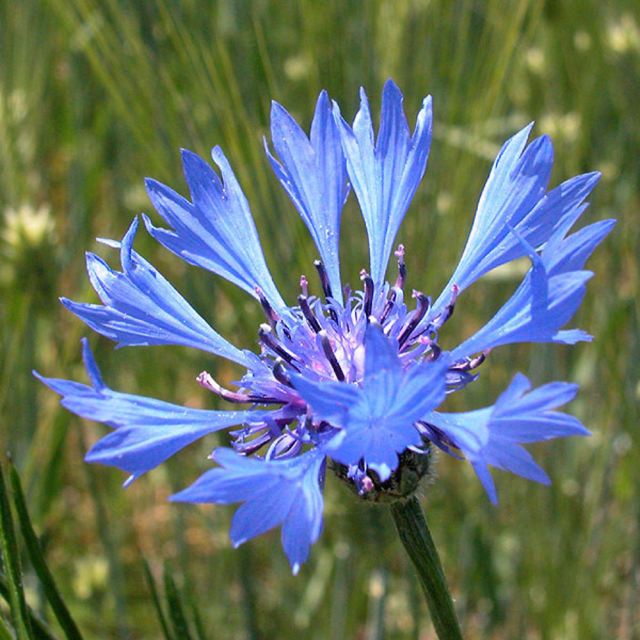
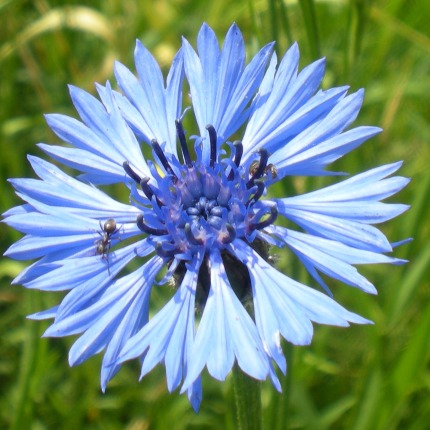
Background information: Flowering May-October. Outer florets usually bright blue, inner florets purple-blue. Flowerheads can also be pinkish, mauve, pale blue. Narrow grey-green leaves, lower stalked, pinnately lobed. Stiff grooved stems with greyish hairs. To 60cm. The use of agricultural herbicides has virtually eradicated this beautiful wildflower from the British landscape, and it is now only seen if seed has been deliberately spread. Since the cornflower needs the same conditions to grow as corn does, it spread over the entire world in thousands of years of agriculture. But due to modern agriculture, especially weed control, the cornflower almost disappeared in many regions.
[wpspoiler name=”Where to find it”]Ireland: Cornflowers were once very common on wasteland and on arable farmland in Britain and Ireland.. In Britain and Ireland Cornflowers grow wild in just a few cornfields where the land is not subjected to heavy doses of 'weedkiller' and artificial fertilliser; there are also odd patches of 'wasteland' where cornflowers still grow wild. For the most part, however, where you see Cornflowers in a wildflower meadow in Britain or Ireland they will have been grown from 'wildflower seed mixtures'.
Greece: Commonly grows wild in fields with cereals or abandoned fields.
Germany: Originally the cornflower comes from the eastern Mediterranean area but is meanwhile spread to the entire world. It grows on corn fields and rubble dips. Due to modern agriculture, especially weed control, the cornflower almost disappeared in many regions.
Poland: In Poland, a common weed field.
Italy:…..[/wpspoiler]
[wpspoiler name=” Cultural aspects(stories/songs)”]Ireland: In folklore, cornflowers were worn by young men in love; if the flower faded too quickly, it was taken as a sign that the man's love was not returned.
Greece: The name of the plant named after the wise centaur Chiron of Greek mythology who used the plant as a therapeutic herb. According to the Greek mythology Chiron was in the side of Hercules in the battle against the Centaurs. Hercules accidentally hurt Chiron in his the leg with an arrow soaked in poison of Hydra. Chiron then used the plant as an antidote herb to heal his wound.
Germany: It was believed that bread goes mouldy if cornflower is taken into the house so the plant was banned from the most homes. In folk medicine cornflower was believed to have magical abilities. A common believe was that the first blossom of cornflower putted on one’s eyes keeps problems away from them for a whole year. The cornflower for a long time was a national symbol for Germany. There is the story that Queen Louise of Prussia was pursued by Napoleon’s troops and hid herself along with her children in a cornflower field. She kept her children quiet by weaving wreaths for them from the flower and escaped that way. The cornflower became a symbol for Prussia and later for the unified Germany, not least because the Prussian military uniform had the same colour. The cornflower is also seen as the inspiration for a famous symbol of the German romantic period called “blue flower”.
Poland: N/A
Italy: …..[/wpspoiler]
[wpspoiler name=”Contemporary use(cuisine/ cosmetics/medicine)”]Ireland: it is also occasionally used as a culinary ornament. Cornflowers have been used and prized historically for their blue pigment. Cornflowers are often used as an ingredient in some tea blends and herbal teas, and is famous in the Lady Grey blend of Twinings. The cornflower is considered a beneficial weed, and its edible flower can be used to add colour to salads.
Greece: It is very commonly used in flower bouquets that highlight their blue colour.
Germany: The tea made of cornflower by using e.g. one teaspoon of the flower dashed with 250ml hot water has an appetising effect and is diuretic. Cornflower is also found in many teas which are good for coughs. Tea-baths prepared with cornflower help with skin disorders and an itching skin. As a footbath a tea mixture with the plant is used against oedema. Furthermore cornflower is used in face lotions, wine and eye drops. The flowers can be boiled in wine to produce a remedy against fever.
Poland: diuretic, choleretic and anti-inflammatory. Due to the very mild anti-inflammatory used in conjunctivitis and in paediatrics. An infusion of the flowers is recommended for kidney disease, inflammatory glomerular and renal pelvis, with heart failure, and kidney stones. Externally, it is used for difficult to heal wounds and ulcers.
Italy: ……[/wpspoiler]
[wpspoiler name=”Traditional use (remedies, uses)”]Ireland: In herbalism, a decoction of cornflower is effective in treating conjunctivitis, and as a wash for tired eyes.
Greece: It is considered beneficial for eye diseases. An eye lotion from leaves can be used.
Germany: In mediaeval times cornflower was believed to be a good medicine against plague. It furthermore was used against eye diseases and served as a mouth wash to treat inflammations in mouth and throat. Blue colour was won from the petals of the plant.
Poland: Ocular brew: mix 4 tablespoons of flowers cornflower, 3 tablespoons herb skylight and 2 tablespoons of chamomile flowers. Put2 tablespoons of mixture 1 cup of boiling water and infuse covered for 15 minutes. Let stand for 15 minutes, strain. Apply warm in inflammation eyes, several times a day.
Italy: …….[/wpspoiler]