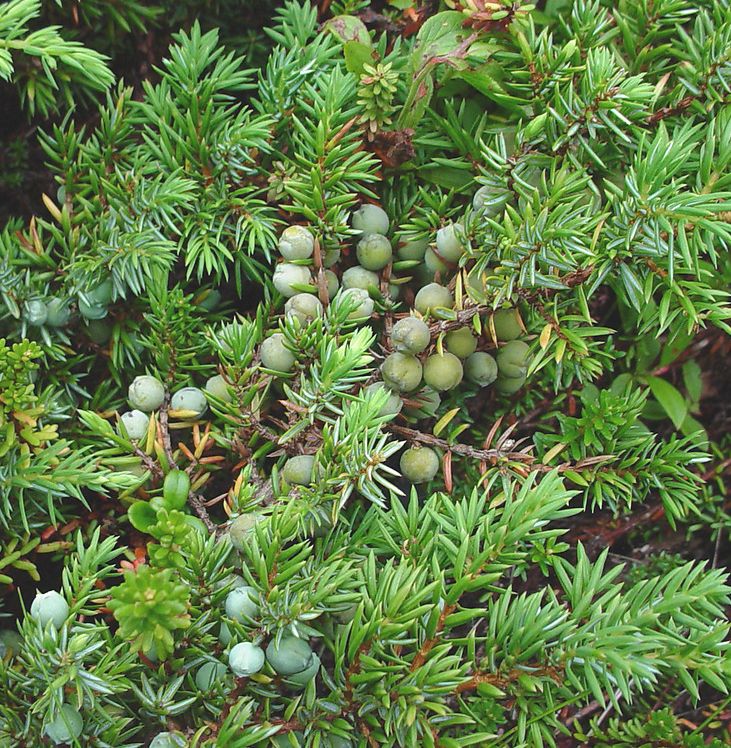
Effects: Bacteriostatic, diuretic effects in medicinal and pharmaceutic application. Juniper preparations are known to eliminate uric acid and are effective lung balsams
Use: Various diterpenes present in the oil stimulate renal epithelium renale, so bestowing volumetric diuretic properties. In cases of renal infection of the lower urinary tracts, they have a bacteriostatic function towards Staphylococcus aureus, staphylococcus pyogenes, Escherichia coli and Salmonella typhoids.
Background information: The active properties of Juniper include its essential oil, which contains myrcene and sabinen as well as diterpene acids and flavonoids.
[wpspoiler name=”Where to find it”]
Ireland: A rarity in Ireland, Juniperus communis may be found on heaths and mountainsides with either acid or alkaline soils, but most examples are to be found on well-drained rocky outcrops and cliff areas based on limestone soils.
Germany: Juniper grows as bush or huge tree. It grows in many gardens but can be also found on poor grasslands or on moorland, in rocky areas or in old native pine woodland on wetter, peaty or acidic soils. Juniper is dioecious, which means that male and female flowers grow on separate trees. At least 2 plants are needed to grow. Its range is shrinking so that the plant is protected; only the berries are allowed to be taken.
Greece: Grows in dry and rocky soils in clearings, meadows and uncultivated places.
Poland: the species is widespread throughout the area. Most abundant in the north-eastern part of the country and the region of Mazovia Bydgoszcz. The relatively most rare in south-western Poland. Locally, the lack of it completely in the areas of intensive agricultural use (Marshland Wiślane Pyrzycka Plain, central Wielkopolska) In the mountains the typical encountered a variety of up to 1350 m (Smytniańskie crags in the Tatra Mountains), a variety of mountain to 2350 meters above sea level (Sharp peak)
Italy: Formations with Juniperus communis of plain to montane levels. They mainly correspond to phytodynamic succession of the following types of vegetation:
a) nutrient poor grasslands, grazed or let lie fallow
b) more rarely, heathlands.[/wpspoiler][wpspoiler name=” Cultural aspects(stories/songs)”]Ireland: Lyrics taken from Jennifer Juniper by Donovan;
Jennifer Juniper lives upon the hill
Jennifer Juniper, sitting very still
Is she sleeping, I don't think so
Is she breathing, yes, very low
Whatcha doin', Jennifer my love
Germany: Wacholder in German. Juniper is mentioned in very many legends and stories. There is a fairy-tale “Von dem Machandelboom” (Brothers Grimm) and in the opera “Hänsel and Gretel” from Engelbert Humperdinck the witch uses a juniper branch to release Gretel from the spell.
For the old Germanic tribes juniper was a holy plant and used to burn the dead.
At the German island Rügen juniper is put in the fundament of a house to hinder the devil in entering the house. And together with straw under the floor it was used against mice.
Greece: (ancient Greek myth) Kyparissos was a charming young man from Kea island. He was the son of Telephus and grandson of demigod Hercules. So this young man was so beautiful that even the ancient gods like Apollo and Zephyr were charmed. Kyparissos had, as a companion a domesticated deer, that he loved. A summer day Kyparissos killed by mistake his beloved deer with a spear. From his despair he asked gods to die. Apollo and Zephyr did not realize his request and instead transformed him into a tree, the Juniperus. The tree was dedicated to Pluto , the god of the dead and emblem of mourning.
Poland: Two-piece name later adopted for the determination of this species only appeared for the first time in the work of Simon Pisulewskiego from 1841 Fri Clusters of the natural plant kingdom, while the common name of the species recognized was the whole of Juniperus . Polish name is derived from the shoddy, or barren wastelands and pastures, which often grows juniper
Italy: In Italy, Juniper is used in the preparation of herbal teas, in aromatic wines and digestives as well as gin (during distillation) and other herb-based liqueuers.[/wpspoiler][wpspoiler name=”Contemporary use(cuisine/ cosmetics/medicine)”]Ireland: A modern use for the wood or to be more precise the wood shavings are as an organic insect repellent. Also, their scent has been found to keep the munching moths away from your clothes drawers or wardrobes.
Germany: In cuisine it is used to flavour meat and added to a traditional German dish – Sauerkraut. Besides, it is added when kippering fish or smoking meat. A nice recipe is also marmalade with apples and juniper liquor.
For medical purposes tea is prepared, tincture, liquor or it can be used as bath additive: Cover 100g chopped juniper berries with 500ml water and cook it for 15 minutes. Added to the bathwater the stock helps in case of rheumatism or gout and is good for the upper airways.
Greece: The fruits taste spicy, slightly bitter with a pleasant fragrance and are used mainly to flavor alcoholic drinks.
They are also used in cooking to flavor sauces. Putting a few drops of essential oil to your shampoo, you reduce the oiliness of your hair. To clean and disinfect the atmosphere use 6 drops of juniper or alternatively 3 drops juniper plus 3 drops eucalyptus. For aching muscles and joints massage add 40 drops to 100ml almond oil and massage gently.
Poland : In aromatherapy essential oil juniper is used to strengthen the forces in the event of internal weakness, getting rid of intrusive and unpleasant thoughts
Italy: The juniper‘s astringent blue-black seed cones, commonly known as "juniper berries", are too bitter to eat raw and are usually sold dried and used to flavour meats, sauces, and stuffings. They are generally used to enhance meat with a strong flavour, such as game, including game birds, or tongue. Medicinally it are used in treating urinary tract cysts as has anti-inflammatory properties.[/wpspoiler] [wpspoiler name=”Traditional use (remedies, uses)”]
Ireland: The stems and branches which provide support for the trees foliage and berries are covered in rich, brownish red bark, which can be seen to shred, curl and peel away in strips from the mature tree. Under the bark, you will find the pinkish white water-filled sapwood similarly aromatic to the pungent foliage. The interior brown heartwood is quite soft and has few if any wood working uses, apart from veneering; instead, it was used for burning because of its scent. The ancient Celts burned the wood of the Juniper at their autumn (Samhain) festival for purification, as an aid to allow contact with the dead.
Germany: An old German proverb says: "Vor dem Holunder zieh den Hut, vor dem Wacholder geh in die Knie." (Doff your hat for elder but kneel down for juniper). And already in the 16th Century Hieronymus Bock wrote in his herbs collection that juniper has more positive effects than he can mention. Juniper berries and their use as remedies are known since centuries. The German name Wacholder derives from “wehdal, wachal” which means strong or fit for life. “der” means tree or bush. According to the folk believe heaven has given the hint to the healing effects of juniper by the voice of a bird. It is supposed to draw all foul and slimy substances out of the body so that it was seen as support for a longer life.
During the Middle Ages wood from juniper trees was burnt in order to force back the pest.
Greece: The fruits contain essential oils which act as diuretic and stimulate the secretion of gastric juice.
Also indicated in the treatment of rheumatism, increases appetite and acts as a laxative
Poland: Dosage : According to the Polish Pharmacopoeia 2002 single dose preparations could not exceed the amount resulting from 2 g of raw material, a daily dose of 5 g
Italy: Dioscorides' De materia medica lists juniper berries, when crushed and put on the penis or vagina before intercourse, as a contraceptive.[/wpspoiler]