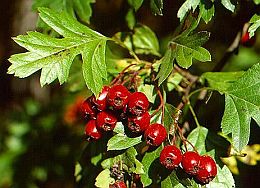
Effects: It is a good source of antioxidant phytochemicals, especially extracts of hawthorn leaves with flower; strengthen cardiovascular function
Use: The plant parts used medicinally are usually sprigs with both leaves and flowers, or alternatively the fruit.
Background information: The haw is a small, oval dark red fruit about 1 cm long, berry-like, but structurally a pome containing a single seed. Haws are important for wildlife in winter, particularly thrushes and waxwings; these birds eat the haws and disperse the seeds in their droppings. Petals are also edible, as are the leaves.
[wpspoiler name=”Where to find it”]Ireland: Agricultural land, hedgerows.
Germany: At the edge of forests and roads, as hedge plant in gardens
Greece: It grows in sparse woods and hedges, and it is a close relative of pyracantha.
Poland: In Poland it is common throughout the lowlands and lower parts of the mountain
Italy: In rocky, wooded and grassy areas. Very prolific in Italy. Distribution: Valle d'Aosta, Piedmont, Lombardy, Trentino-Alto Adige, Veneto, Friuli-Venezia Giulia, Liguria, Emilia-Romagna, Tuscany, Marches, Umbria, Lazio, Abruzzo, Molise, Campania, Puglia, Basilicata, Calabria, Sicily, Sardinia.
[/wpspoiler][wpspoiler name=” Cultural aspects(stories/songs)”] Ireland: In Celtic lore, the hawthorn plant was used commonly for rune inscriptions along with Yew and Apple. It was once said to heal the broken heart. The red fruit is, or was in living memory, called the Johnny MacGorey or Magory. In Gaelic folklore, hawthorn (in Scottish Gaelic, Sgitheach and in Irish, sceach) 'marks the entrance to the otherworld' and is strongly associated with the fairies. Lore has it that it is very unlucky to cut the tree at any time other than when it is in bloom. Method of satire from the hilltop, 7 poets on hill with hawthorn, each sang their satire and left perforated stone and thorn under the bush – if the satire was wrong they would be swallowed up and if right the king & his heirs would perish.
Germany: Slavic sources show that whitethorn was used for the protection against vampires and a pole made of whitethorn was staken into the heart of revenants. The Germanic god Odin staked Brunhilde with whitethorn to put her into a deep sleep.
Witches that are on the way to the mount Brocken in Germany, make a rest in whitethorn-trees.
Greece: N/A
Poland: N/A
Italy:
Oh! Valentino, once again attired
as the hawthorn pitchers !
only, from your bramble-scratched legs
do you bring the skin of your feet;
do you bring the shoes mamma made you,
which never changed you since that day,
never cost you so much as a petiole: but
cost you instead the dress I sewed.
Translation from Oh Valentino by Giovanni Pascoli (1855-1912)
[/wpspoiler][wpspoiler name=”Contemporary use(cuisine/ cosmetics/medicine)”]Ireland: Leaves picked in spring when still young are tender enough to be used in salads
Germany: Whitethorn is used in salads, also marmalade and liquor is made of it
To prepare the liquor take: 400g whitethorn berries, 8 rosehips, 2 benches of balm, 150g brown sugar and 1 bottle of rum or vodka (0,7-1l).
After washing all ingredients should be put in a demijohn. After 6-8 weeks it is ready.
Greece: 1. It is used primarily for disorders of the heart and circulatory system, particularly for angina. 2. Berries jam keep their medicinal properties for the heart.
Poland : The fruits are edible raw, but more suitable for preserves.
Italy: The fruits of the Hawthorn are edible, though mostly they are not consumed fresh in Italy but rather used in the preparation of jams, jellies or syrups.
[/wpspoiler][wpspoiler name=”Traditional use (remedies, uses)”]Ireland: Tinctures were traditionally made and used as remedies for the heart
Germany: In the south German region Allgäu there was the custom that pregnant women should have three thorns of the whitethorn on their left side in order to facilitate the birth.
Whitethorn also was supposed to help against toothaches when collected Good Friday at 3 am. With the thorn one should stake around the tooth until it bleeds. And in rural areas people thought that they can get rid of diseases when creeping through a whitethorn hedge. The same was done with animals that should loose parasites.
But besides these customs that today sound strage, whitethorn was well known as remedy for the heart, e.g. in a tea made with leaves, flowers and also the berries. Hot water should be poured over 2 tea spoons of this mixture. After 5 min. the tea is ready.
Greece: 1. Berries help digestion and against indigestion and diarrhea. 2. Flowers alone or with other sedative plants are against insomnia and discomfort of menopause.
Poland: The major flower hawthorn active compounds are flavonoids, responsible for the spasmolytic effect of vascular smooth muscle (including witeksyna and its glycosides, rutoside, hiperozyd, kaempferol), and oligomeric procyanidins.
Italy: Once commonly used in delineating the confines of country plots as its entwined branches created an impenetrable barrier.[/wpspoiler]