
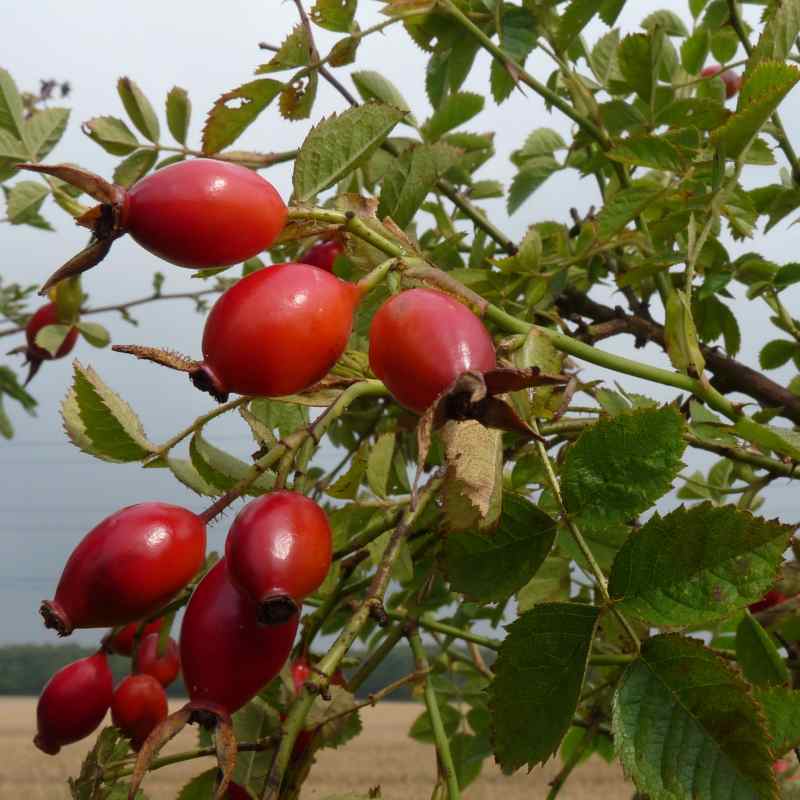
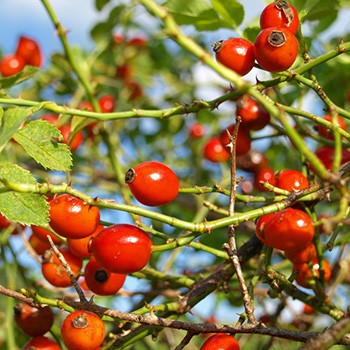

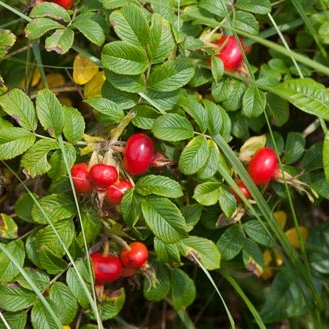
Effects: Rose hips are particularly high in vitamin C content, one of the richest plant sources available. Rose hips contain the carotenoids, beta-carotene, lutein, zeaxanthin and lycopene, which are under basic research for a variety of potential biological roles, such as inhibiting oxidation of low density lipoprotein. Diuretic and laxative, bacteriostatic, cancer preventative, anti-infectious.
Use: The fine hairs found inside rose hips are used as itching powder. Tea, cosmetics, oil, jam, soup, source of vitamin C, A, B1, B2.
Background information: There are two varieties of wild rose that produce a hip; both are members of the Rosacea family. Rosa Canina (the common rose, dog rose, briar rose, hip tree, itchy backs) and Rosa Rugosa (the Japanese rose). The former is the true wild rose of the country while Rosa Rugosa, tolerates salt spray and wind and is fully naturalised as a hedgerow plant in coastal areas and, more recently, planted on road embankments. A Rose hip grows up to ten feet tall and bears a white, very fragrant flower. Once the flower has bloomed, and all the petals have fallen off, the hip is picked and used in a wide variety of preparations.
[wpspoiler name=”Where to find it”]Ireland: Hedgerows, wasteland, the edges of woodlands, and a bandoned homesteads often growing alongside brambles. Rosa Rugosa is common near the seashore, particularly spreading in the hedgerows from houses.
Greece: Rosehip shrub is native to the slopes and glades.
Germany: Rosehip can be found at forest edges and in brushes. In the alps rosehip can be found up to 1500 m.
Poland: It is very common and you can find mainly outside the big cities in forest and wood.
Italy:…..[/wpspoiler]
[wpspoiler name=” Cultural aspects(stories/songs)”]Ireland: N/A
Greece: An poetic song about the sacred full star night and the aroma of the white small roses of rosehip. http://youtu.be/tgucBBwdxUEN/A
Germany: There is a still widespread folk song from August Heinrich Hoffmann von Fallersleben from the year 1843: “A little man stands in the forest completely still and quiet. He wears a little, pure purple cloak. Say! Who can that little man be? Who stands there alone in the forest, with the little crimson cloak? The little man stands in the forest on one leg, and has on his head a little, black cap. Say! Who can that little man be, who stands there alone in the forest with the little, black cap? Spoken: The little man out there on one leg, with his little, red cloak and his little black cap can only be the rose hip”. For children the fine hair on the nuts of rosehip is a classic source of itching powder.
Poland: N/A
Italy: …..[/wpspoiler]
[wpspoiler name=”Contemporary use(cuisine/ cosmetics/medicine)”]Ireland: The hips of both types are edible and can be used to make jellies, preserves, sauces and wine. Rose hips are commonly used as a herbal tea, often blended with hibiscus, and also as an oil. Dried rose hips are also sold for primitive crafts and home fragrance purposes.
Greece: The fruit can become syrup, jam or marmalade, which are excellent nutritional supplements.
Germany: Rose hip nowadays is used for tea, jam, soup, and as a natural source of vitamin C. The fresh rosehip contains a lot of vitamin C and can be used for preventing and treating colds, flu, and vitamin C deficiencies. Its puree is used to treat gout and rheumatism, the oil won from rose hip is used in cosmetic products for skin care due to its high amount of vitamin A. It helps regenerate new skin cells and is used to treat scars, acne and burns. Furthermore it helps to keep the skin elastic and nourished and prevents wrinkles.
Poland: With the flakes are made preserves, particularly suitable for filling donuts.
Candied rose for decorating cakes, and are in addition to potpourri.
With fruit produced jams, juices, syrups and concentrates vitamin. Preparations of rose suitable for self-consumption, are also used to flavor sweets, drinks, cakes.
With fruit and cereal gets aromatic teas
Italy: ……[/wpspoiler]
[wpspoiler name=”Traditional use (remedies, uses)”]Ireland: In the mediaeval times wild roses were grown in monasteries as a medicinal herb.
Greece: Fruits and flowers contain a high amount of vitamin C and is medicine for rickets. The decoction is considered ideal tonic to infections of the respiratory system, colds, weakness, anorexia and indigestion.
It is an effective antiseptic for infections and irritation of the eyelids and eyes.
In traditional medicine it is known that the rosehip tea increases the body's immunity.
Germany: Once used as a folk remedy for chest ailments, Rose hip was popular in the Middle Ages. They are a natural source of vitamin C, which has led to their widespread use in natural vitamin supplements, teas, and various other preparations including soups and marmalades. Although these products have been used historically as nutritional supplements, they also have been used as mild laxatives and diuretics. Rose hip syrup was used as a nourishing drink for children and to flavor teas and jams.
Poland: Raw Herb: ripe fruit (Fructus Rosae). Are used in numerous herbal mixtures. Contain in addition to the huge amounts of vitamin C, tannins, carotenoids, organic acids, essential oils, sugars, pectin. Fruit is very rich in vitamin C – contain ten times more than its blackcurrant. Already 1-3 its fruits are enough to meet the daily requirement for this vitamin support. Natural vitamin contained in the fruit is at the same time three times more effective than synthetic vitamin tablets. Fruits of rose can be used for the preparation of milk and wine Rosehips also contain vitamins A, B1, B2,, E, K and folic acid, flavonoids, organic acids, pectins and tannins
Italy: …….[/wpspoiler]